Caught in the Net of Samsara: A Field Guide to Waking Up
Explore the four types of spiritual seekers in Vedanta through Ramakrishna's classic parable of the fisherman's net and discover how to find true freedom.
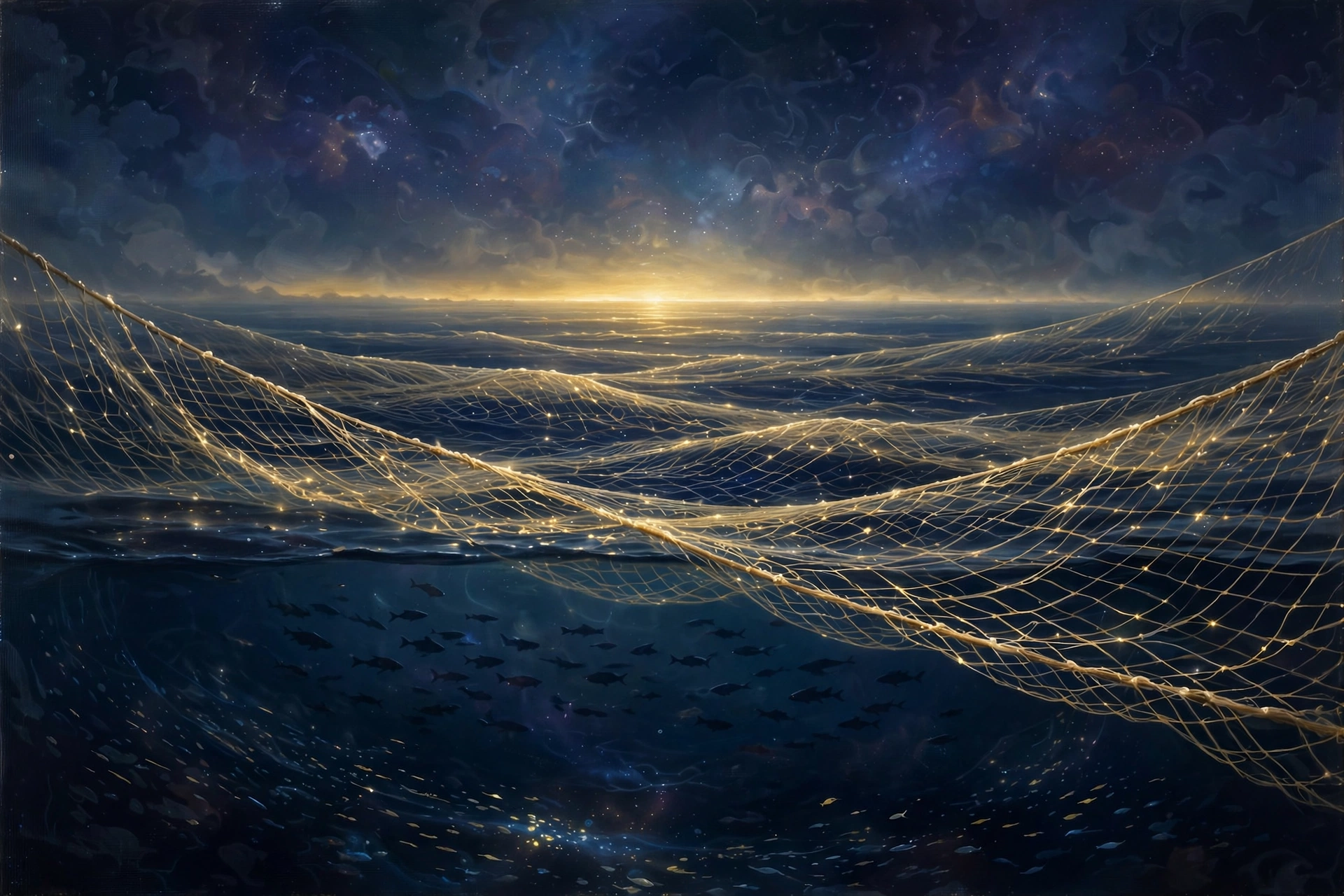
Years ago, I spent an entire morning watching an old fisherman throw a cast net into the shallows of a coastal creek. If you have ever seen a hand-thrown net in flight, you know how effortless it looks from the wooden dock. The net leaves the thrower’s arms as a coiled heap of monofilament, blossoms in midair into a wide circle, and meets the surface with a gentle hiss. Lead weights sewn around the border drag the circle downward, trapping whatever happens to be idling in the brackish shallows. But if you were underneath the surface looking up, you would see something far more unsettling. The sky darkens for half a second. A web of fine mesh drifts down through the green water and pins the weeds to the floor. The curious thing is that the water inside the mesh feels identical to the water outside it. A fish inside the ring can still glide two feet to the left and two feet to the right. Nothing bites its tail. Nothing constricts its gills. So the fish does what any comfortable creature does when a subtle disturbance passes overhead: it noses downward, wriggles into the silt, and convinces itself that everything is fine. This picture gives us a stark, honest look at the net of samsara, the ancient spiritual term for the cycle of worldly entanglement that surrounds us before we even realize we have lost our freedom.
We live our everyday lives inside categories. We sort our mail, file our taxes, divide our neighbors into political factions, and classify our own personalities with four-letter psychological acronyms. It feels orderly. It gives the mind a sense of control over a world that is far too vast and turbulent to comprehend. Yet the great teachers of Vedanta never bothered classifying human beings by their social rank, their wealth, or their ancestry. When Sri Ramakrishna spoke of human categories while sitting in his room at Dakshineswar back in the winter of 1882, he reached for that very image of the fisherman’s net. He saw the world as a stretch of water, the divine creative power as the fisherman, and the rest of us as fish swimming through the river.
According to that teaching, there are four kinds of beings in this world: the bound, the seekers of liberation, the liberated, and the ever-free. It is an extraordinary classification, not because it flatters us, but because it tells the raw truth about where we spend our energy. When you first hear it, your mind immediately wants to place you in the highest possible category. We like to think of ourselves as daring seekers or spiritually liberated souls who simply happen to have a mortgage. But if we are honest with ourselves when the lights are off and the house is quiet, where are we actually swimming?
The Comfort of the Mud
The first group in the old teaching consists of the bound, known in Sanskrit as the baddha. These are the vast majority of fish in the river. They are caught inside the mesh, but they have no awareness that a net has fallen over them, nor do they suspect that the boat waiting above will soon haul them out of the water.
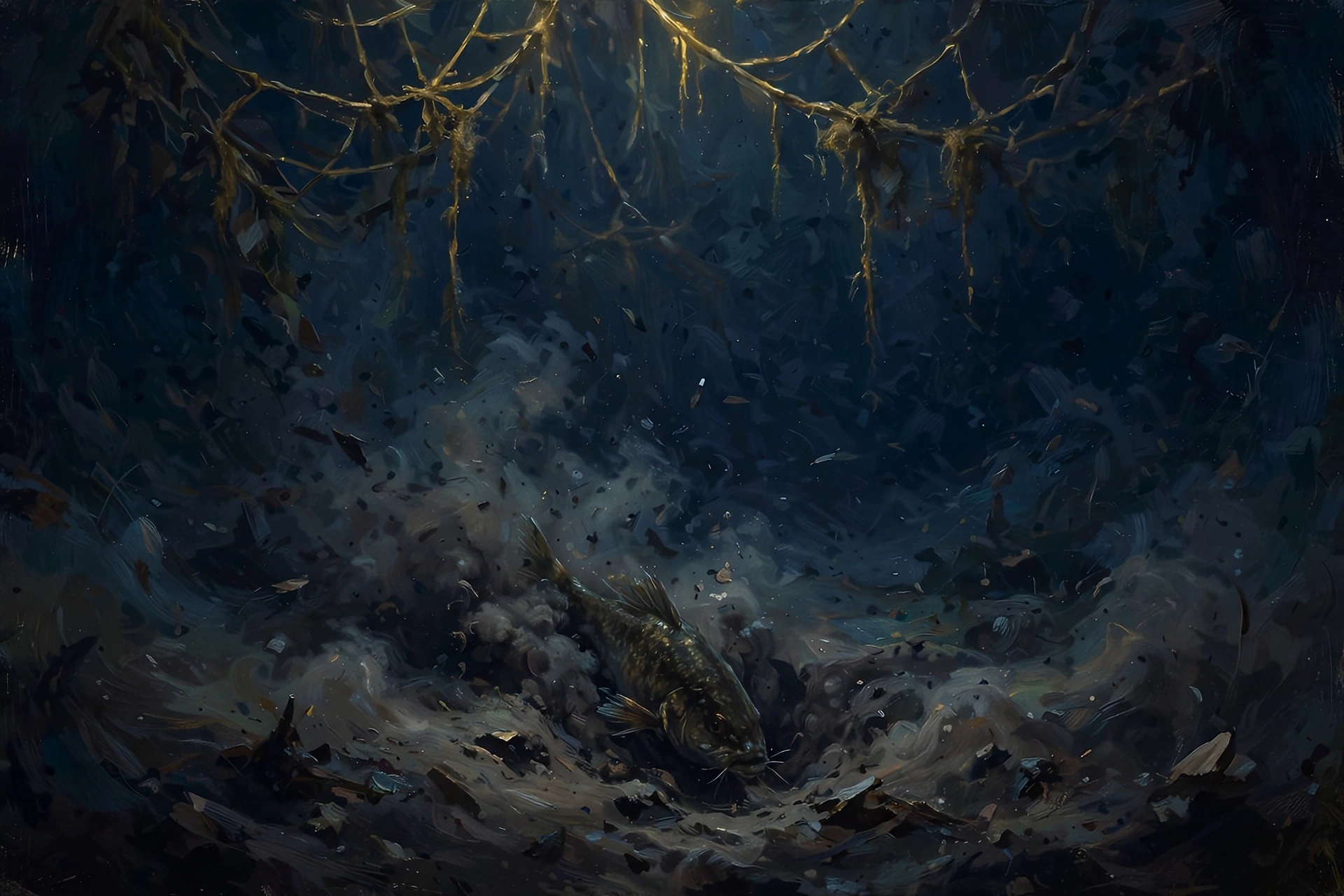
When the lead weights hit the bottom, these fish do not panic. In fact, they do something that looks remarkably like common sense: they burrow into the silt. They press their bellies into the cold mud, tuck their fins close, and feel an immense wave of relief. The mud feels familiar. It is soft, dark, and thick. They look around at the immediate inch of silt in front of their faces and say to themselves, “I am safe here. This is my home. Nothing can touch me now.”
Does that sound familiar? It should, because it describes our most common psychological reflex. Consider what happens when life produces a tremor of existential dread. You receive an unexpected medical bill, or you watch a news report that makes your stomach turn, or you sit at your kitchen table and suddenly realize that twenty years have passed and you have not answered any of the questions that truly matter to your soul. What is your immediate reaction?
Almost always, we dive for the mud. We grab the smartphone off the counter and scroll through twenty minutes of short videos. We open the refrigerator door, stare into the cool light, and look for something sweet. We organize a closet, balance a spreadsheet, or initiate a petty argument with our partner about whose turn it was to run the dishwasher. These are all ways of burying our heads in the silt. We immerse ourselves in the small, manageable friction of domestic life because the alternative, looking up and seeing the cords of the net, is terrifying.
The bound soul is not evil. The bound soul is simply preoccupied. Ramakrishna described this state with vivid words: immersed in worldliness, chasing physical pleasures, accumulating possessions, and feeling thoroughly secure within the trap. The tragedy of the bound fish is not that it is in danger, but that it interprets its prison as a sanctuary. It builds an identity out of the very mud that will soon suffocate it when the net is hauled onto the deck. It is completely convinced that safety lies in digging deeper into the very substance that confines it.
The Shock of the Nylon Cords
Then comes the second group: the strivers, the mumukshus. These are the fish that realize something is terribly wrong.
What causes a fish to stop digging in the mud? Usually, it is not a philosophical treatise. It is the sudden, jarring feeling of a boundary where there used to be open water. Perhaps the fisherman begins to pull the central drawstring, and the circle begins to shrink. The fish swims forward expecting the open river, and its snout strikes a hard, unforgiving cord of nylon. It turns to the left; another cord. It turns to the right; the same diamond-shaped mesh.
In human life, this is the moment the bottom drops out of your ordinary security. It might be the death of a parent, the sudden end of a long marriage, a sudden illness, or simply a prolonged period of burnout where all the toys and titles you worked thirty years to acquire suddenly taste like dry ashes. You realize that no amount of money can purchase ten extra minutes of breath when your heart stops. You realize that your social standing is a vapor. You feel the boundary of mortality pressing against your face.
This realization hurts. It is not peaceful, and it is not romantic. It produces an acute, restless panic. The mumukshu is the person who can no longer sleep comfortably in the mud. The old distractions stop working. You try to watch a movie, but you find yourself staring past the screen, wondering who is watching the film. You sit in a board meeting, and the passionate debate over corporate quarterly earnings strikes you as a play staged by marionettes. You know you are caught.
So what does the striving fish do? It thrashes. It beats its tail against the water. It charges straight at the mesh, trying to tear through the cords with brute force.
In our spiritual lives, this thrashing takes the form of relentless, aggressive effort. We buy every translation of the Upanishads we can find. We attend ten-day silent retreats and sit until our knees throb with agony. We practice breathing techniques until our ribs ache, repeat mantras until our tongues are raw, and debate the fine points of non-dual philosophy with strangers on the internet. We try to think our way out of the trap, plan our way out of the trap, and meditate our way out of the trap.
There is great nobility in this struggle, but there is also immense suffering. Every sincere seeker knows the peculiar exhaustion of spiritual ambition. You want liberation so badly that your desire for enlightenment becomes its own knot. You trade the worldly cords of money and status for the spiritual cords of purity and attainment. You are still inside the perimeter, only now your snout is bruised and your fins are torn from hitting the net over and over again. Ramakrishna noted that many fish try to escape, but only a few succeed. Most simply spend their lives battering themselves against the walls of their own minds.
Seeing Through the Net of Samsara
This brings us to the third class of beings: the liberated, the muktas. These are the fish that actually make it out.
Ramakrishna described them with a memorable image: they leap straight out of the water with a loud splash, clearing the corkline of the net entirely. On the riverbank, the fishermen drop their pipes, point out across the water, and shout, “Look there! There goes a big one!” The fish hangs suspended in the sunlight for one brilliant, breathless instant, and then dives deep into the open current, far beyond the reach of the lead weights.
What is that leap? If brute force rarely tears the net, how does the liberated soul escape?
Here, the profound insights of Advaita Vedanta and Kashmir Shaivism illuminate the mechanism. The leap is not an athletic achievement of the ego. It is not something the individual fish does through sheer willpower. The leap is an act of radical recognition.
In Advaita, the fundamental teaching is that the boundary separating you from the open water is an illusion born of misidentification. You believe you are an isolated, vulnerable creature trapped inside a hostile environment. You take yourself to be the physical body and the restless mind. But who is aware of the net? Who is aware of the fear, the struggle, the thrashing, and the mud? That awareness itself has no edges. It has no cords. It cannot be caught by nylon because it is immaterial. The moment you recognize that your true nature is the unconditioned awareness in which the entire river appears, the net loses its power to hold you. You do not have to break the cords once you see that they are made of your own conceptual projections.
Kashmir Shaivism carries this realization one step further into an even bolder territory. In that tradition, the net is not a cosmic mistake or an alien prison imposed by a distant creator. The net is the supreme consciousness itself, freely choosing to contract into the form of an individual. Shiva, pure universal awareness, voluntarily limits His own power, knowledge, and freedom so that He can experience the drama of being a creature in the world. The five sheaths of limitation, the cords that bind us, are woven from the very same divine energy that constitutes the open ocean.
When you see this, the struggle changes completely. The fish does not have to fight the water to escape the net. It realizes that the net, the water, the fisherman, and the open sea are all expressions of one single, unbroken light. The leap out of the net is simply the sudden, joyous laughter of the soul recognizing its own divine identity. The cords do not break; they become transparent.

The Open Ocean and the Ever-Free
Finally, the old master spoke of the fourth class: the ever-free, the nitya. These are the rare beings who never get caught in the first place.
Throughout history, a handful of souls seem to walk through the world without a single grain of dust clinging to their feet. In the ancient Indian stories, sage Narada wanders through heaven and earth, singing songs of devotion, completely immune to the gravitational pull of worldly greed and vanity. We see hints of this in historical sages who, from early childhood, showed not the slightest inclination toward self-preservation, accumulation, or social vanity. They look at gold and clay with the exact same calm neutrality. They pass through the world like wind passing through an open window.
For those of us who spend our days wrestling with our desires, the ever-free can seem almost alien. We look at their lives and think, “That is fine for an incarnation or an ancient saint, but what does that have to do with me? I have an overdue electric bill, an aching back, and an unruly mind.”
It is easy to turn the idea of the ever-free into an excuse for spiritual laziness, or conversely, an object of distant worship that has no bearing on our real lives. Yet non-dual philosophy insists on a startling truth: at the level of your deepest reality, you are already one of the ever-free.
Consider your own direct experience right now. You are reading these words on a screen or a printed page. Thoughts are arising in response to these sentences. Perhaps a memory surfaced a moment ago, or a slight physical sensation in your shoulders caught your attention. Now look at the awareness that knows these things.
Has that awareness ever aged? Has it ever been stained by an embarrassing mistake you made ten years ago? Has it ever been sick, poor, frightened, or trapped? When you were five years old, that silent presence of knowing was there. When you were twenty, it was there. It is here right now as your eyes scan this line.
The thoughts change constantly. The emotions rise and fall like waves. The body alters with every passing season. But the open space of witnessing consciousness remains untouched, perfectly still, and infinitely wide. The secret of the nitya class is not that they possess a special, miraculous human body, but that they never, even for a fraction of a second, mistake themselves for the fish. They remain rooted as the open river itself.
An Honest Inventory of Our Days
It is comforting to read about ancient typologies, but philosophy without self-inquiry is just another layer of mud. It becomes another intellectual pastime, another way to feel sophisticated while remaining firmly inside the mesh.
The real test comes when we turn these ancient categories onto the raw texture of our everyday life. If we want to know what kind of fish we are, we have to watch ourselves not when we are sitting quietly on a meditation cushion, but when life pulls the drawstrings tight.
Ask yourself honestly: when was the last time you felt the net twitch?
Perhaps it happened this morning when an email arrived with news you did not want to hear. What did your mind do within the first ten seconds? Did it expand into open awareness, resting in the calm witness? Or did your stomach clench, your breathing turn shallow, and your thoughts immediately begin scheming, defending, and planning? That instinctive tightening is the fish rushing headlong toward the bottom.
Look at how much of your day is dedicated to fortifying your captivity. We spend immense amounts of energy decorating our particular corner of the net. We buy better furniture, collect more prestigious credentials, seek more flattering compliments, and arrange our routines so that nothing unpredictable can shake our composure. We act as if we can negotiate a permanent truce with mortality. We behave as though we are the one exceptional creature that will somehow remain in the river after the net is pulled onto the dry deck of the boat.
How much of what you do between sunrise and sunset represents a genuine effort to break free? How much of your daily schedule is spent inquiring into the nature of the self, sitting in unadorned silence, or releasing the petty grievances that keep your heart small and contracted?
Most of us have to admit that we live as a strange, uncomfortable hybrid. Part of us is still the bound fish, loving the warmth of the mud and dreading any change that threatens our comfort. Another part of us has become the striving fish, bruised from bumping against the limitations of our own ego, exhausted by spiritual striving, yet unable to go back to the peaceful ignorance we once enjoyed. Once you have seen the cords of the net, the mud never feels quite as cozy as it used to. You can still bury your head in it, but the silt tastes bitter now.
Stepping Into the Current
What, then, is the way forward for someone caught between the mud and the leap?
The first step is simply to stop digging. That sounds easy, but it requires extraordinary courage. It means that the next time you feel the sting of loneliness, the ache of boredom, or the sudden panic of your own mortality, you do not reach for your phone. You do not pour a drink. You do not start planning your next vacation. You simply stay there. You sit entirely still on the riverbed, keep your fins quiet, and let the silt settle around you until the water turns clear.
When you stop stirring up the mud of your own reactions, something miraculous happens: the water clears up, and you can finally see the net for what it is. You see that your fears are just passing ripples. You see that your self-protective thoughts are small, mechanical habits that have no real substance. You see that the boundary that seemed so solid is made of nothing more substantial than memory, habit, and belief.
You do not need to tear the net with violent effort. You only need to notice who you are before the next thought arises. In that gap between two thoughts, where is the boundary? Where is the confinement? Where is the separation between your small heart and the great, pulsing life of the universe?
The net of samsara is real only so long as you insist on being a separate, fragile fish. The moment you remember that you are the living water that fills both the inside of the net and the vast, boundless ocean outside it, the fisherman has nothing left to catch. The cords pass right through you. The lead weights drop away into the deep. And without taking a single step, without making a single splash, you find that you have been free the entire time.